
Best RV Solar Generators for Boondocking and Backup
Quick Note: Solar Generators are great, but they can’t do everything. If you have roof space, I always recommend a rooftop solar system over a portable system. More bang for your buck and more POWER!
A solar generator combines a battery, an inverter, and a charge controller in one portable unit. For RV use, the key chemistry to understand is LiFePO4, or lithium iron phosphate. These batteries handle deep daily cycling far better than older lead-acid or standard lithium-ion packs. LiFePO4 cells typically last 3,000 to 6,000 charge cycles before dropping to 80% capacity, which translates to a decade or more of regular use. That matters when you are counting on the unit to restart every morning for a month-long trip across the Southwest.
Before buying, pay close attention to three numbers: usable capacity in watt-hours (Wh), continuous AC output in watts, and solar input limits. Capacity determines how many hours you can run your fridge, CPAP, or fan. Output determines whether the unit can actually start and sustain those loads. Solar input limits determine how quickly you can recover from overnight drain. Weight and handle design also matter in a real RV setup, where you may be lifting and repositioning panels and the station frequently.
- Best for weekend campers and teardrop trailers: Jackery Solar Generator 1000 v2 with 200W Solar Panel
- Best for Class B vans and multi-day trips: EF ECOFLOW Solar Generator Delta 2 with 220W Solar Panel
- Best for full-size motorhomes and home backup: EF ECOFLOW Delta 3 Ultra with 400W Solar Panel
- Best for fast recharging on the road: Anker SOLIX C1000 Gen 2 Portable Power Station
- Best compact unit for serious 3kWh capacity: BLUETTI Elite 300 Solar Generator with 2x200W Solar Panels
Jackery Solar Generator 1000 v2 with 200W Solar Panel

A solid entry-level solar generator for weekend boondockers who need reliable power for a 12V fridge, phone charging, and LED lighting without a heavy or complicated setup.
Pros
- At 23.8 lbs, it is one of the lightest 1kWh units available
- LiFePO4 battery rated for 4,000 cycles with 10-year lifespan estimate
- App-controlled fast charging, including a 1-hour emergency charge mode
Cons
- 200W panel is undersized for quick recovery after a heavy overnight draw
- 1,500W continuous output will not sustain most RV rooftop air conditioners
- App required to unlock the fastest charging speed, which adds friction in the field
The 1000 v2 is comfortable to carry and reposition during a typical campsite setup. The foldable handle and compact footprint (about 13 x 9 x 10 inches) fit easily in a truck bed or cargo bay. Expect the included 200W panel to recover roughly 80% of a depleted battery in around six hours under good sun.
For practical load planning: a standard 12V/24V compressor fridge pulling 40 to 50 watts continuously will consume around 300 to 360Wh overnight. That leaves meaningful reserve for a CPAP machine, phone charging, and LED lights. What the 1000 v2 cannot do is run a 1,500W draw continuously for extended periods, or power a rooftop AC unit. Pair it with a second 200W panel if your daily energy consumption regularly exceeds 600Wh.
The three pure sine wave AC outlets are an important detail. Pure sine wave output protects sensitive electronics like CPAP machines and laptop chargers from distortion damage that modified sine wave inverters can cause.
EF ECOFLOW Solar Generator Delta 2 with 220W Solar Panel

The Delta 2 with its bifacial 220W panel is a well-rounded pick for Class B van campers and teardrop trailer owners who need more output headroom and expandability than a basic 1kWh unit provides.
Pros
- 1,800W continuous AC output handles more appliances simultaneously than most 1kWh competitors
- Expandable up to 3kWh with add-on battery packs
- Bifacial solar panel captures up to 25% more energy in bright, reflective conditions
Cons
- At 27 lbs for the station alone, it is heavier than the Jackery 1000 v2
- 3,000-cycle LFP rating is lower than some competing LiFePO4 units
- 15 total outlets can feel like overkill, adding bulk to the unit design
The Delta 2 accepts up to 500W of solar input, which means adding a second 220W panel gets you close to full capacity on the input side. The MPPT charge controller inside handles mixed panel voltages reasonably well, though wiring two panels in series versus parallel changes both your voltage and current behavior. Know your panel specs before connecting.
In real-world RV scenarios, 1,024Wh supports a full night of CPAP use (roughly 30 to 60Wh per night on a mid-range machine), a 12V fridge, and phone and laptop charging without breaking a sweat. The 1,800W output will handle a small portable induction burner in short sessions, though sustained cooking from battery alone will drain the pack quickly.
Expandability is the Delta 2’s biggest long-term advantage. If your power needs grow, adding a DELTA 2 Extra Battery gives you up to 3kWh without buying a whole new unit.
EF ECOFLOW Delta 3 Ultra with 400W Solar Panel
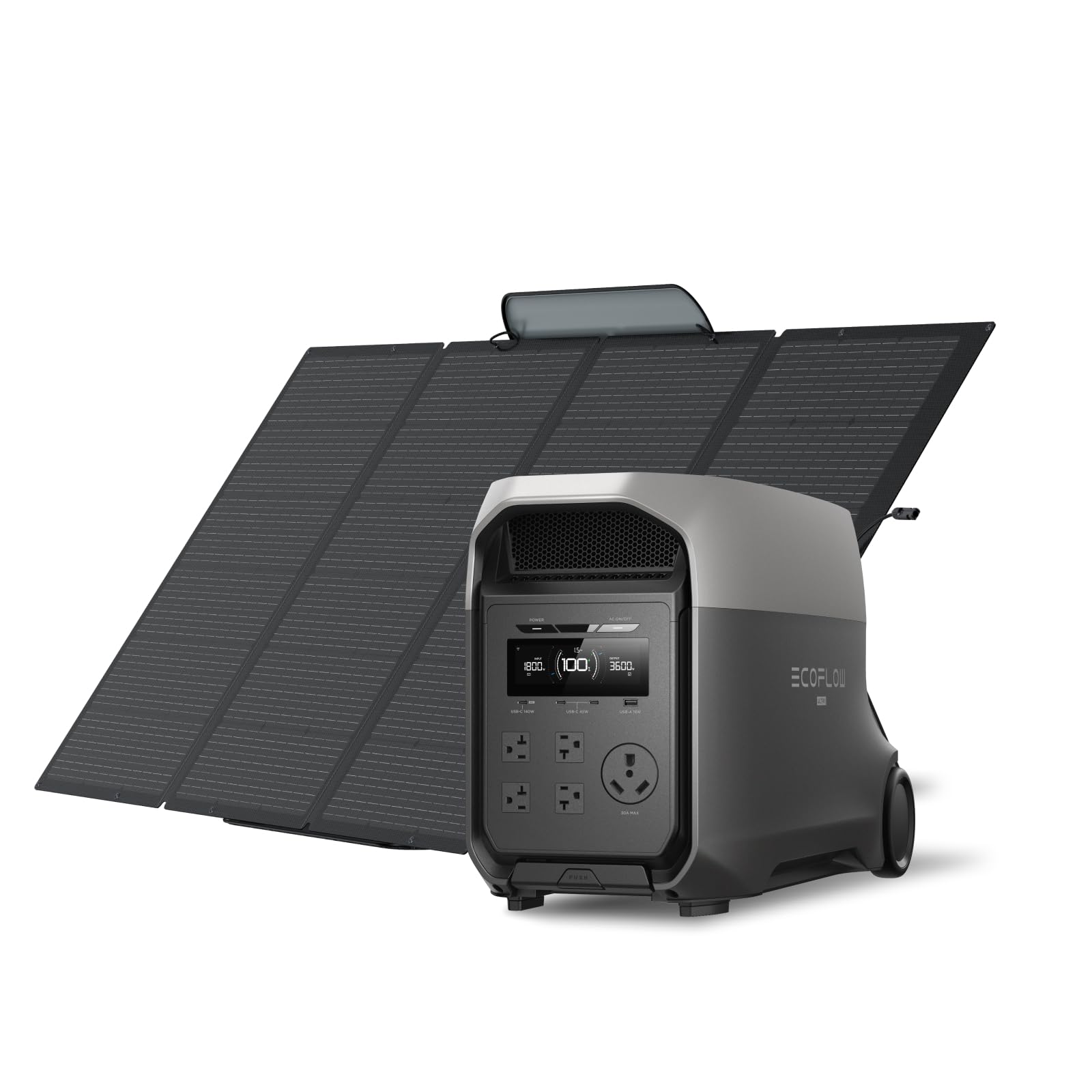
This is the unit for full-size RV owners, overlanders running high-demand setups, or anyone who needs 3kWh of LiFePO4 capacity paired with serious solar recovery, though the 400W panel requires careful handling.
Pros
- 3,600W continuous output (7,200W surge) handles heavy loads including large power tools and microwaves
- 3,072Wh capacity supports multi-day boondocking without a generator top-up
- Under-10ms UPS switchover protects sensitive electronics during power interruptions
Cons
- 400W panel is large and heavy, making repositioning during the day impractical solo
- Newer product with fewer long-term owner reviews compared to the Delta 2 lineup
- Large footprint (24.6 x 12.9 x 15.6 inches) requires dedicated storage space in smaller rigs
The 400W bifacial panel is a serious piece of hardware. The panel charges the Delta 3 Ultra efficiently under full sun. However, its size and flexible-yet-floppy construction make it awkward to set at an optimal angle without a solid secondary support. The included kickstand case handles flat or low-angle placement, but steep pitch requires supplemental bracing.
Expect a fully depleted 3,072Wh battery to take a long time to recover on solar alone. With a single 400W panel in ideal conditions, plan for eight to twelve hours. Budget realistically: a partly cloudy day in the desert can easily cut that output by 40 to 60%.
The 3,600W continuous output is what separates this unit from 1kWh competitors. Running a microwave, an electric kettle, or power tools for short bursts is well within spec. Sustained RV rooftop AC on battery alone is still not realistic for most scenarios, but supplemental cooling during mild weather or short intervals becomes possible.
Anker SOLIX C1000 Gen 2 Portable Power Station
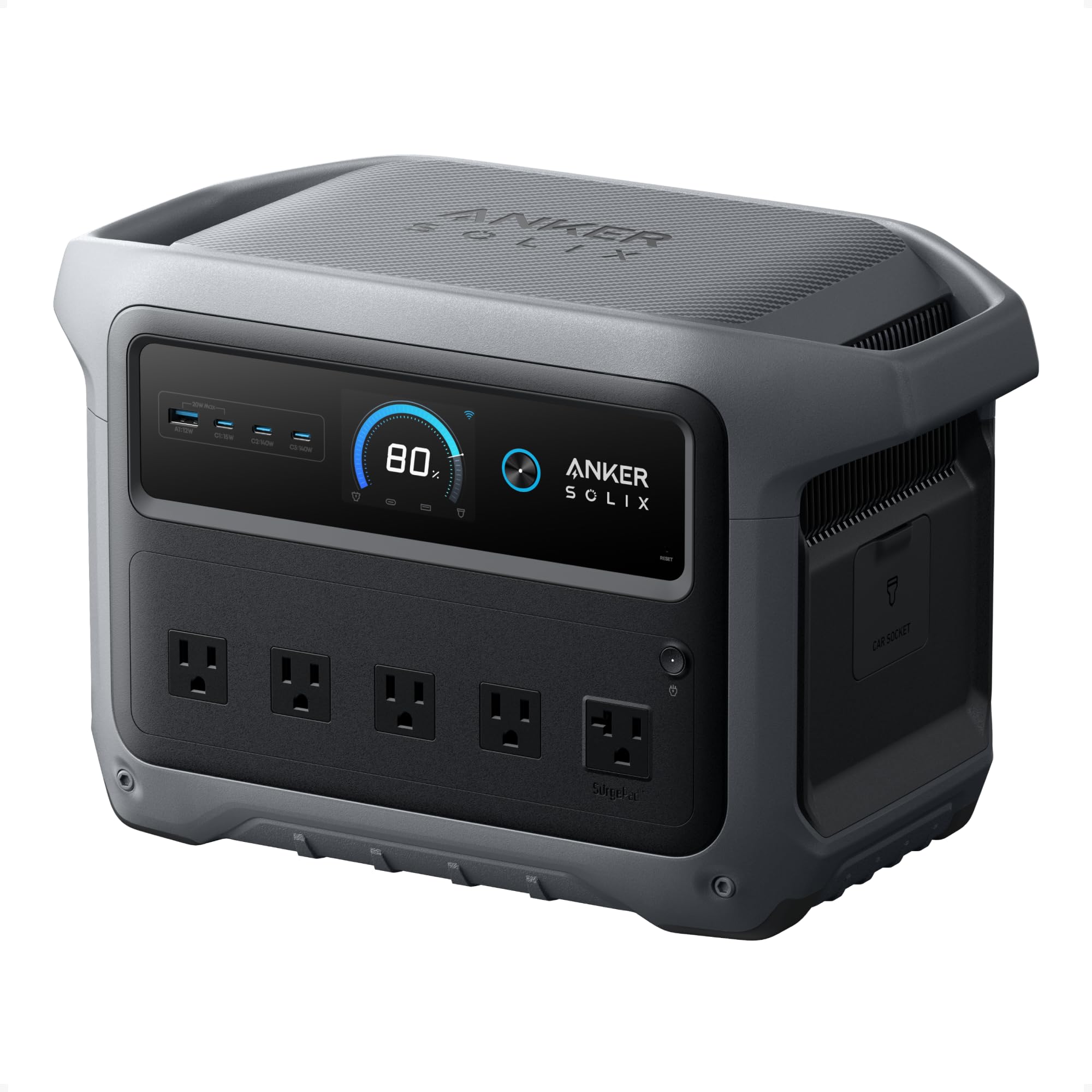
The SOLIX C1000 Gen 2 earns its place on this list because of its remarkably fast recharge speed, which makes it an ideal choice for overlanders who have access to shore power or a generator between outings.
Pros
- Wall charges from empty to full in around 49 minutes with HyperFlash enabled via the app
- 2,000W continuous output with 3,000W surge in a compact, lighter-than-average form factor
- 4,000-cycle LiFePO4 battery with 80% capacity retention
Cons
- Solar panels are sold separately, adding cost and selection decisions
- At 2,000W output, it falls short of the Delta 3 Ultra for the heaviest RV loads
- HyperFlash fast charging requires enabling through the app each session
The C1000 Gen 2 is noticeably compact for a 1kWh unit. At under 25 lbs, it is manageable for a single person to lift into a cargo area or position on a picnic table.
Solar input tops out at 600W, which means pairing two 300W panels gets you to theoretical maximum recovery. In the field, a single 200W panel paired to this unit will recover most of a moderate overnight draw (300 to 400Wh) in four to five hours of good sun. Extension cable length and panel placement affect MPPT efficiency, so keep cable runs short and aim for direct sun exposure without shading across cells.
The 10ms UPS switchover is a practical feature for CPAP users and remote workers who use a laptop. It keeps sensitive devices running through a momentary power swap without a restart.
BLUETTI Elite 300 Solar Generator with 2x200W Solar Panels
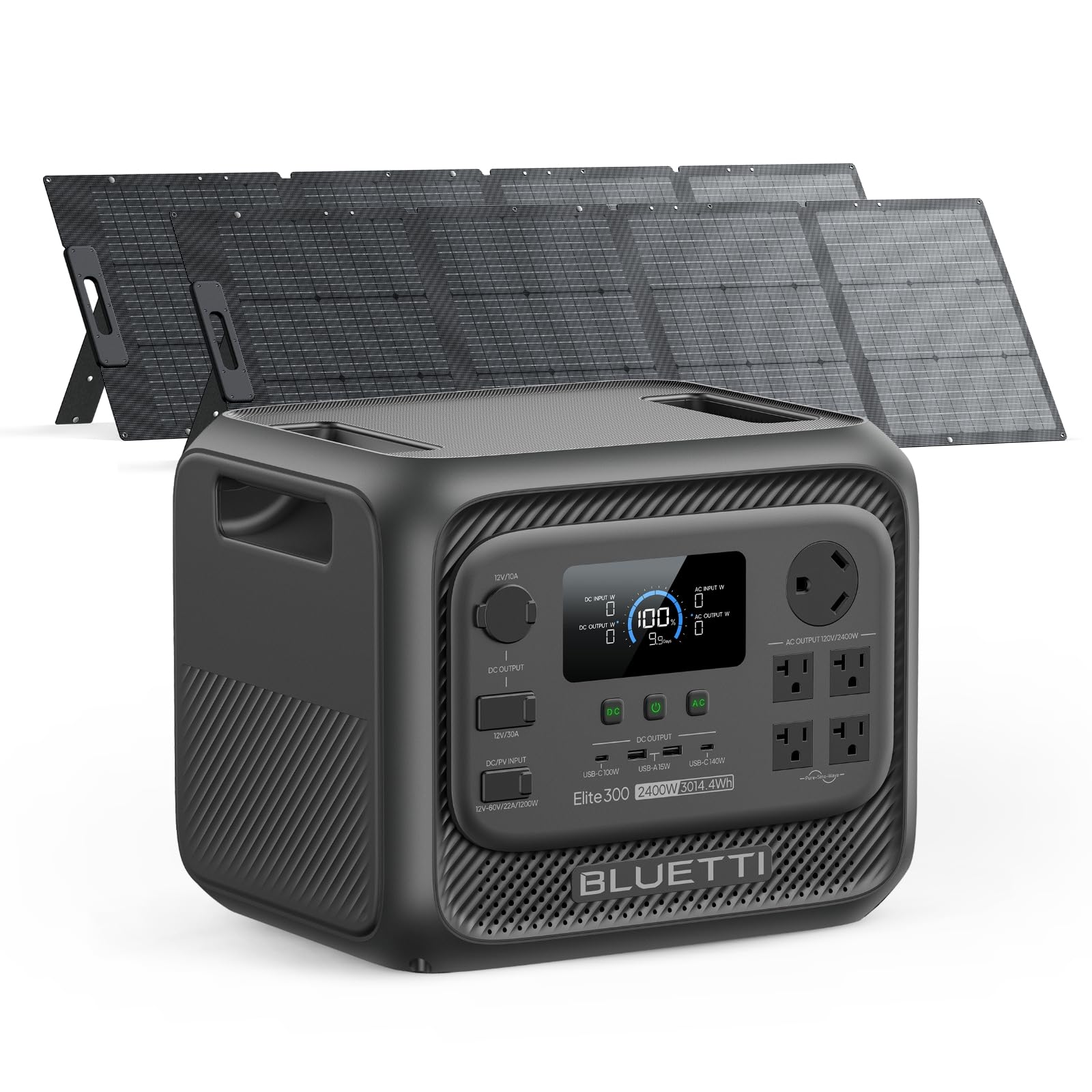
The BLUETTI Elite 300 packs a full 3kWh into a notably smaller physical footprint than most competitors in this capacity class, making it a strong choice for RV owners who need big capacity without sacrificing storage space.
Pros
- 3,014Wh LiFePO4 battery with 6,000-cycle rating in a compact 14.4 x 12 x 11.7-inch chassis
- Dedicated TT-30 RV outlet and 12V/30A DC port for direct, adapter-free RV connections
- 4,800W surge capacity handles resistive loads that stall lower-surge units
Cons
- Very few owner reviews available as of May 2026, so long-term real-world performance data is limited
- Weighs 58 lbs, requiring two people to lift safely during setup or repositioning
- Two 200W panels (400W combined) take seven to fifteen hours to fully recharge from empty
The TT-30 outlet is a standout feature for Class A and Class C motorhome owners. Most solar generators force you to run through an adapter to plug into an RV’s 30-amp shore power inlet. The Elite 300 eliminates that step, which simplifies a backup power setup considerably during an outage or a stay at a primitive campsite.
The 6,000-cycle LFP rating is the highest on this list. For someone using the unit daily over years of full-time RV travel, that lifecycle advantage compounds into a lower effective cost per cycle compared to units rated at 3,000 cycles.
The two included 200W panels work adequately for slow recharging over a full day. Backcountry Solar recommends wiring them in series to raise voltage and improve MPPT efficiency, especially in partially overcast conditions where low current from parallel wiring can reduce harvest noticeably.
Buying Guide
Choosing the right solar generator for an RV comes down to matching three things: how much energy you actually use overnight, how fast you can recharge during the day, and how much weight and bulk you are willing to manage. Marketing specs are a starting point, not a guarantee.
Estimate Your Real Energy Needs
Before looking at any product, add up what you actually want to run and for how long.
| Appliance | Typical Draw | 8-Hour Use Estimate |
|---|---|---|
| 12V compressor fridge | 40-50W | 320-400Wh |
| CPAP (no heat, no humidifier) | 30-40W | 240-320Wh |
| LED cabin lights (4 bulbs) | 20-30W | 160-240Wh |
| Laptop charging | 45-65W | 90-130Wh (2 hrs) |
| Phone charging (2 phones) | 20-30W | 20-30Wh total |
| Box fan | 25-50W | 200-400Wh |
A typical overnight boondocking scenario for two people with a fridge, a fan, CPAP, and device charging lands between 800 and 1,200Wh. That points you toward a 1kWh unit at minimum for a single night, with a 2kWh or 3kWh unit if you want two or more nights without a recharge.
Understand Battery Chemistry
LiFePO4 (also called LFP) is the right chemistry for regular, deep-cycle RV use. It tolerates high discharge depth (80 to 90%) without accelerated degradation, unlike older lithium-ion chemistries. It is also safer in high heat environments, which matters in a summer RV cabin.
Solar Recharge Realities
A solar panel’s watt rating is a peak figure measured under ideal lab conditions. In the field, expect 70 to 85% of rated output on a clear day with good panel angle. A 200W panel realistically delivers 140 to 170W under good conditions.
Key charging formula: Wh (Watt-Hours) needed divided by realistic panel output equals hours of sun required.
For example, recovering 800Wh on a 200W panel producing 160W real-world output takes five hours of direct sun. Shade, clouds, or a flat panel angle can stretch that to eight hours or more.
Matching Panel Voltage to Your Charge Controller
Most portable solar generators use an internal MPPT (maximum power point tracking) charge controller. MPPT handles variable solar input efficiently, but each unit has a maximum input voltage. Wiring two panels in series doubles voltage; wiring in parallel doubles current. Always check the unit’s maximum solar input voltage before connecting panels in series.
Continuous Output vs. Surge Power
Continuous output (measured in watts) is what the inverter can sustain indefinitely. Surge power is a short burst for starting motors, like a fridge compressor. Pay attention to both numbers. A unit with 1,500W continuous output may still start a 2,000W surge load, but it cannot sustain that draw.
Weight and Portability Trade-offs
| Capacity Range | Typical Weight | Best Fit |
|---|---|---|
| 1kWh | 22-28 lbs | Teardrop, weekender, van supplement |
| 1-2kWh | 27-35 lbs | Class B van, truck camper, frequent moves |
| 3kWh+ | 55-65 lbs | Class A/C motorhome, base camp, stationary setup |
Units over 50 lbs typically require two people to lift safely and are best treated as semi-permanent installs rather than grab-and-go gear.
Decision Checklist by RV Type
Teardrop or small trailer:
- 1kWh capacity is usually sufficient for a couple
- Prioritize weight under 25 lbs
- A single 200W panel covers moderate daily use
Class B van or truck camper:
- 1 to 2kWh handles most two-person setups
- Look for 1,800W or higher continuous output
- Two panels (400W total) allow reasonable same-day recovery
Full-size Class A or Class C motorhome:
- 3kWh or more for multi-day independence
- Prioritize high continuous output (3,000W+) for cooking and tools
- Consider expandability for future battery adds
What Solar Generators Cannot Reliably Do in an RV
Set realistic expectations. Rooftop RV air conditioners typically draw 1,200 to 1,800W continuously and cycle frequently. Running one from a portable solar generator for hours is not practical on battery alone. The same applies to electric resistance water heaters and large induction cooktops at full power. Use propane or generator-assisted power for those loads, and reserve your solar generator for everything else.